
Golf Simulator Ceiling Height Guide
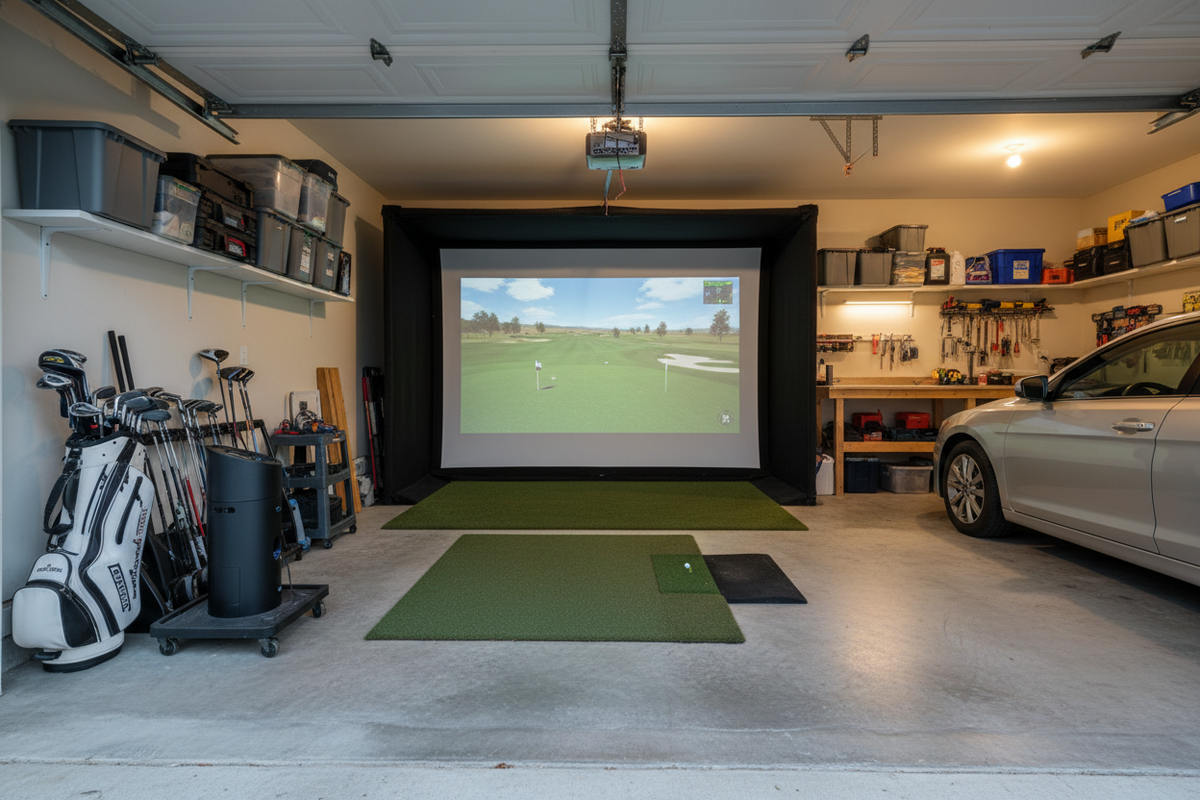
Golf Simulator
Ceiling Height Guide
What you actually need, what you can work with, and how to make a tight space function — before you buy a single piece of equipment.
Ceiling height is the one room dimension you genuinely can't work around. You can adjust your hitting position, swap projectors, or resize your screen — but if your ceiling is too low to swing a driver, no piece of equipment fixes that. This guide gives you the real numbers, explains what changes as you move above or below them, and covers your options if you're working with a tighter space.
How Much Ceiling Height Do You Actually Need?
The industry standard minimum is 9 feet — but that's a floor, not a goal. Here's what different ceiling heights realistically mean for your setup and your swing.
| Ceiling Height | Verdict | Reality Check |
|---|---|---|
| 8 ft or under | Not viable | Full driver swing not safely possible for most golfers. Wedges and irons only — and even then it's uncomfortable. |
| 9 ft | Workable | Meets the minimum. Fine for average-height golfers with moderate swing planes. Taller players (6'2"+) may still feel restricted. Beams and ductwork can eliminate your buffer here. |
| 10 ft | Recommended | The sweet spot for most home setups. Comfortable driver swing for the large majority of golfers, and enough headroom for standard projector and enclosure equipment. |
| 11–12 ft | Ideal | No compromises. Full swing freedom for tall golfers, steep swing planes, and high-arc shots. Also gives more flexibility on projector placement and screen height. |
Four Things That Affect How Much Height You Need
The 9-foot minimum assumes an average golfer with a moderate swing. In practice, your specific clearance needs depend on a combination of factors — some obvious, some not.
Golfer Height
A 5'8" golfer and a 6'4" golfer need meaningfully different clearance. Taller players have a higher arc on the backswing and follow-through. If you're over 6 feet, add at least 6 inches to whatever minimum you'd otherwise use.
Swing Plane
Upright swing planes require more vertical clearance than flatter ones. If your natural tendency is a steep backswing, your club head traces a higher arc — especially with a driver. When in doubt, test with a slow practice swing before committing.
Obstructions
Your effective ceiling height is the clearance at your lowest obstacle — beams, ductwork, sprinkler heads, light fixtures. A 10-foot ceiling with a 9-inch beam directly above the hitting zone is functionally a 9'3" ceiling. Measure at the hitting position, not the tallest point in the room.
Club Length
Drivers and fairway woods have longer shafts that create a wider swing arc. If you're primarily practicing with irons or working on short game, you can function comfortably in a slightly lower space than a full-swing setup requires.
How to Test Your Space Before Committing
Don't rely on the number alone. Take five minutes to physically confirm your clearance before ordering equipment.
-
01Grab your longest club — the one with the highest backswing arc, which is almost always your driver.
-
02Stand in the planned hitting position and take a slow, full backswing. Note how close the club head comes to the ceiling at its highest point.
-
03Repeat facing the other direction — the follow-through can be just as high as the backswing depending on your swing shape.
-
04Check from both sides of the mat if you're planning a setup that right-handed and left-handed golfers will share — the dominant arc shifts with handedness.
If Your Ceiling Is on the Lower End
A 9-foot ceiling doesn't have to mean giving up. There are legitimate strategies for making a tighter space work — it just requires being deliberate about a few choices.
Know Your Ceiling Height?
Use our Simulator Finder to get equipment recommendations matched to your exact space — ceiling height, room depth, and budget all factored in.
Find Your Simulator →